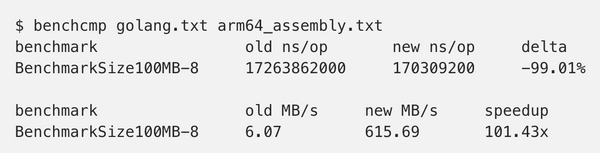
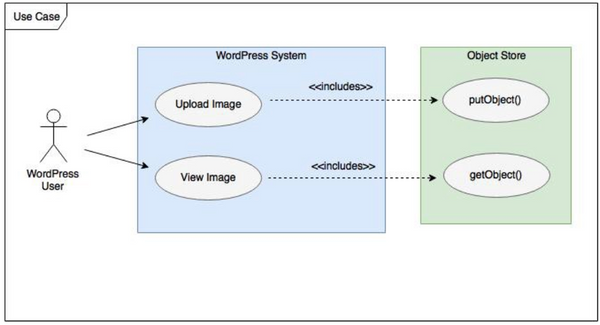
MinIO provides integration with a range of backend systems which enables you to build a complete solution for your projects. The team has recently integrated a pull request from the community to add Webhook support and wanted to tell you a bit about it.
Read more
Data loss is more frequent that we think. Whether you lose data from your laptop
or a mission critical application server, it can be devastating. You may not
have faced it yourself, but think of people close to you — friends, family,
colleagues—and you’ll find several instances of people losing critical personal
or business data.
To avoid such loss,
Read more
In this post, I explain how to use NGINX and NGINX Plus as a reverse proxy and load balancer for MinIO servers.
Read more
Applications today generate
[https://blog.minio.io/object-storage-what-is-it-all-about-62920ca164ca#.qfa0ylbd1]
more data than ever, and this upward trend is expected to keep up
[https://www.emc.com/leadership/digital-universe/2014iview/executive-summary.htm]
in foreseeable future. How do you handle this ever growing storage requirement
of your application? A storage solution that can run where your application runs
and can scale with
Read more
Introduction
Minio [https://www.minio.io/] server supports Amazon S3 compatible bucket event
notification for following targets AMQP [https://www.amqp.org/about/what],
Elasticsearch
[https://www.elastic.co/guide/en/elasticsearch/reference/current/getting-started.html]
, Redis [http://redis.io/documentation], nats.io [http://nats.io/], PostgreSQL
[https://www.postgresql.org/] and Apache Kafka [http://kafka.apache.org/]. Part
4
Read more
Introduction
Minio [https://www.minio.io/] server supports Amazon S3 compatible bucket event
notification for following targets AMQP [https://www.amqp.org/about/what],
Elasticsearch
[https://www.elastic.co/guide/en/elasticsearch/reference/current/getting-started.html]
, Redis [http://redis.io/documentation], nats.io [http://nats.io/], PostgreSQL
[https://www.postgresql.org/] and Apache Kafka [http://kafka.apache.org/]. Part
3
Read more
Introduction
Minio [https://www.minio.io/] server supports Amazon S3 compatible bucket event
notification for following targets AMQP [https://www.amqp.org/about/what],
Elasticsearch
[https://www.elastic.co/guide/en/elasticsearch/reference/current/getting-started.html]
, Redis [http://redis.io/documentation], nats.io [http://nats.io/], PostgreSQL
[https://www.postgresql.org/] and Apache Kafka [http://kafka.apache.org/]. Part
2
Read more
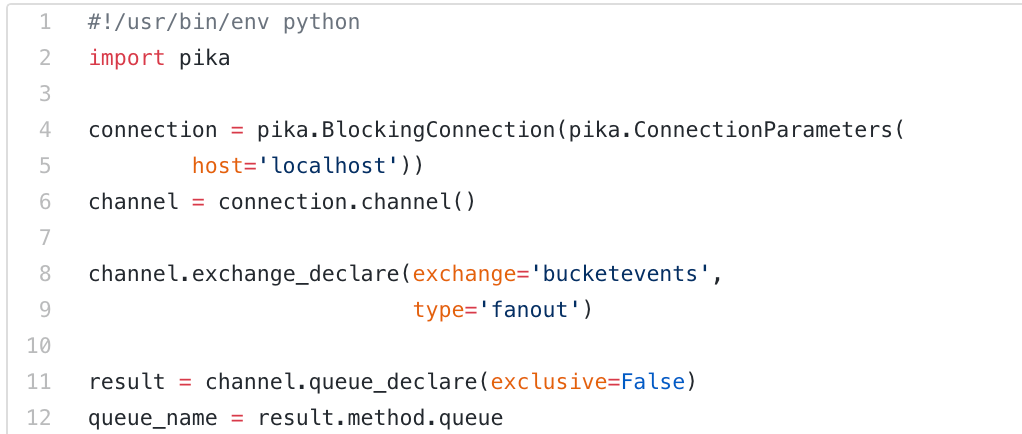
Introduction
Minio [https://www.minio.io/] server supports Amazon S3 compatible bucket event
notification for following targets AMQP [https://www.amqp.org/about/what],
Elasticsearch
[https://www.elastic.co/guide/en/elasticsearch/reference/current/getting-started.html]
, Redis [http://redis.io/documentation], nats.io [http://nats.io/], PostgreSQL
[https://www.postgresql.org/] and Apache Kafka [http://kafka.apache.org/]. Part
1
Read more
s3verify performs a series of API calls against an object storage server and checks the responses for AWS S3 signature version 4 compatibility. s3verify is licensed under Apache V2.0 license.
Why we built s3verify
Amazon Web Service’s (AWS) Simple Storage Service (S3) has emerged as the goto cloud storage, so any new competing service has a strong incentive
Read more
If you are interested in app development for the cloud then Minio Server
[https://github.com/minio/minio] is a great choice for storing your data. If
you just want to back up and share some of your most important files and images
to one or more cloud storage services then Minio Client (mc) is going to be
right up
Read more
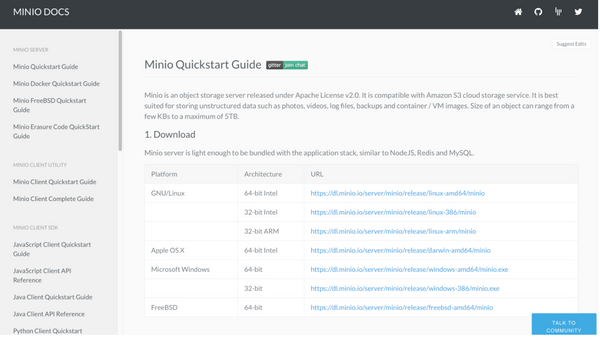
Doctor uses markdown (MD) format for documentation and github for version
control. Use Doctor to aggregate multiple MD files from across repositories into
a single documentation site. Doctor is licensed under Apache V2.0 license.
See a live demo : https://docs.minio.io [https://docs.minio.io/]
docs.minio.ioWhy we built Doctor
We wanted a documentation server to simply
Read more
This article shows you how to configure Elasticsearch to store snapshots and
metadata in Minio [http://minio.io]. Minio is an object storage server built for
cloud application developers and devops and compatible with Amazon S3 object
storage.
The current aws cloud plugin of Elasticsearch has been build with an older
version of the Amazon SDK, causing several issues. We’
Read more
Logging remains one of the major concerns among developers. Typically, various
components like the web servers, databases store logs at different locations.
When something goes wrong, developers need to look all around to find the
relevant logs.
Wouldn’t it be nice to have your application logs automatically stored at a
predefined location. You can do this with Fluentd and
Read more
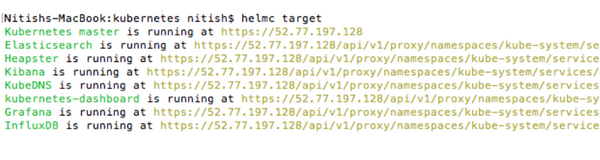
Whether you notice it or not, as an end user, storage is an important component
of almost all the software we use today. As a developer however, it is important
is to be able retrieve stuff in an easy yet secure and fast way. As I mentioned
earlier
[https://blog.minio.io/object-storage-what-is-it-all-about-62920ca164ca#.wnnc8hyfs]
, Object storage is a great way
Read more
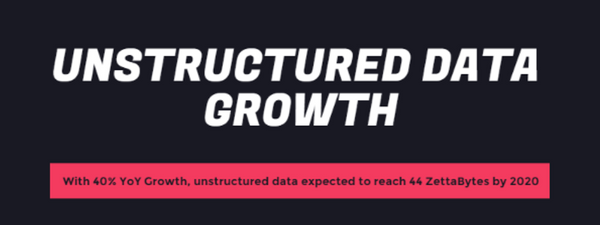
Traditionally web applications used file systems and databases to store user
data in the back-end. It was simple, structured data goes to the database and
anything else goes to the file system. This was easy to manage, since rarely an
application generated unstructured data — most of the applications took user
input in forms and saved the data to database. However,
Read more
This new release adds support for Solaris/Illumos and FreeBSD 64bit Intel.
Following is the non exhaustive list of changes in this release.
* Parallel code for cp and mirror is deprecated and removed. All copy
operations are serial now, this fixed a number of issues related to session
file missing and overall code complexity.
* All cli operations now standardize on
Read more