How Nomura Modernized Risk Infrastructure with MinIO AIStor

Executive Summary
Nomura’s Risk Advisory division transformed its data infrastructure by modernizing from an aging Hadoop environment to a hybrid object-native data lakehouse powered by MinIO AIStor. This shift delivered measurable gains in performance, stability, and scalability, reducing operational costs and risk, while improving data availability and supporting future AI and analytics workloads.
Key benefits included:
- Performance: Benchmarking demonstrated 13.9% higher throughput compared to Hadoop
- SLA compliance: Performance improvements led to a 4 hour reduction in processing time, significantly reducing the risk of breaching SLAs
- Efficiency: Usable storage capacity increased from one-third to three-quarters of total raw HDD disk space (2+ improvement).
- Developer Productivity: A consistent S3 fabric eliminates the need to bifurcate code to support 2 different APIs
- Time to Value: AIStor was deployed within 2 weeks, compared to 4 months with HDFS
The Environment
Nomura, a global investment bank, relies on its Risk IT organization to generate daily market and credit risk metrics across its trading activities. This operation processes roughly 1.8 billion rows of data daily and writes them into a 700-column table within its Hadoop infrastructure. As the firm expanded its data volumes and complexity, its legacy systems became challenged with demanding SLAs tied to regulatory reporting.
Challenges
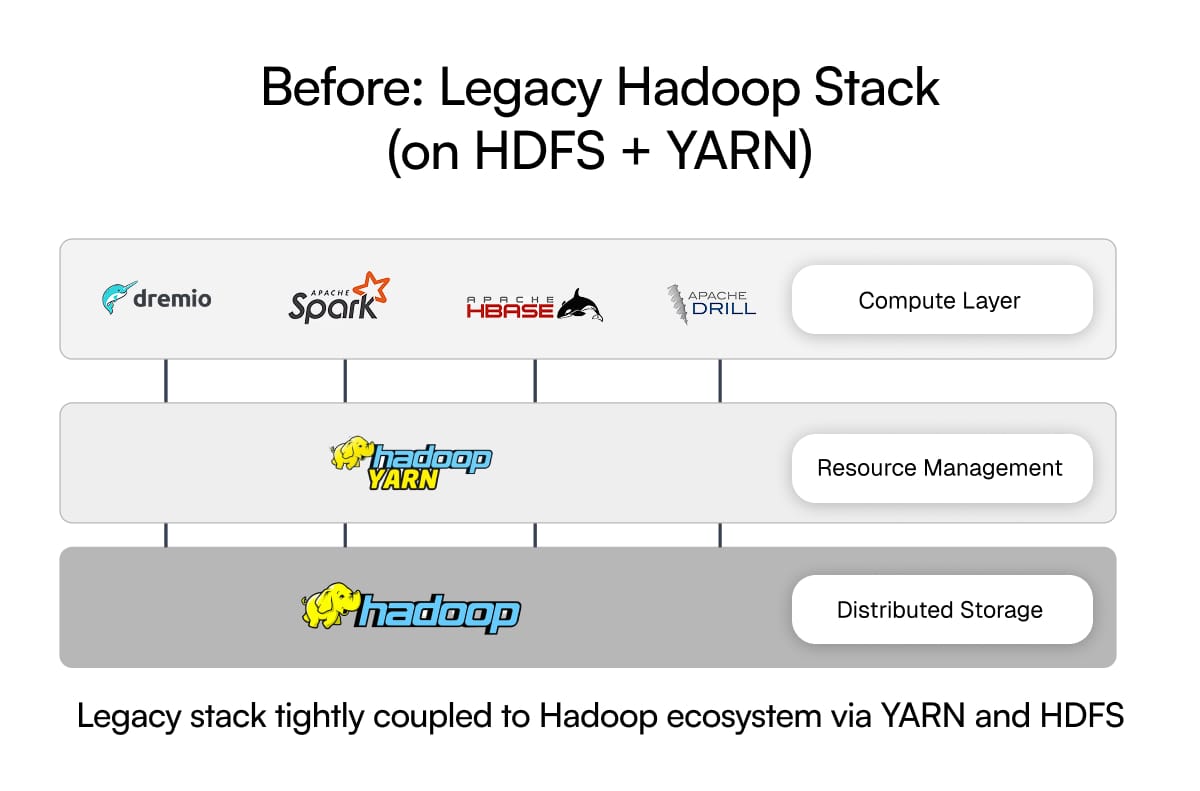
While Dremio was able to support Nomura’s analytics requirements, the Hadoop-based storage layer presented several business challenges. Outages and instability created the risk of missed SLAs and regulatory exposure. Engineers lacked visibility into query performance, complicating diagnostics and slowing innovation. The Hadoop File System (HDFS) tightly coupled storage and compute, forcing teams to scale both simultaneously—driving inefficiency and increasing costs. Additionally, scheduled downtime for upgrades disrupted analytics operations. Nomura needed a modern, stable, and efficient architecture capable of scaling cost-effectively and non-disruptively
The Vision
Nomura envisioned a self-service data platform that combined on-premises control with cloud-native agility. The goal was to decouple compute from storage, enabling flexible, cost-efficient scaling and simplified management. By modernizing its environment, Nomura aimed to deliver faster risk insights and lay the foundation for AI-driven analytics.
The Solution: MinIO AIStor
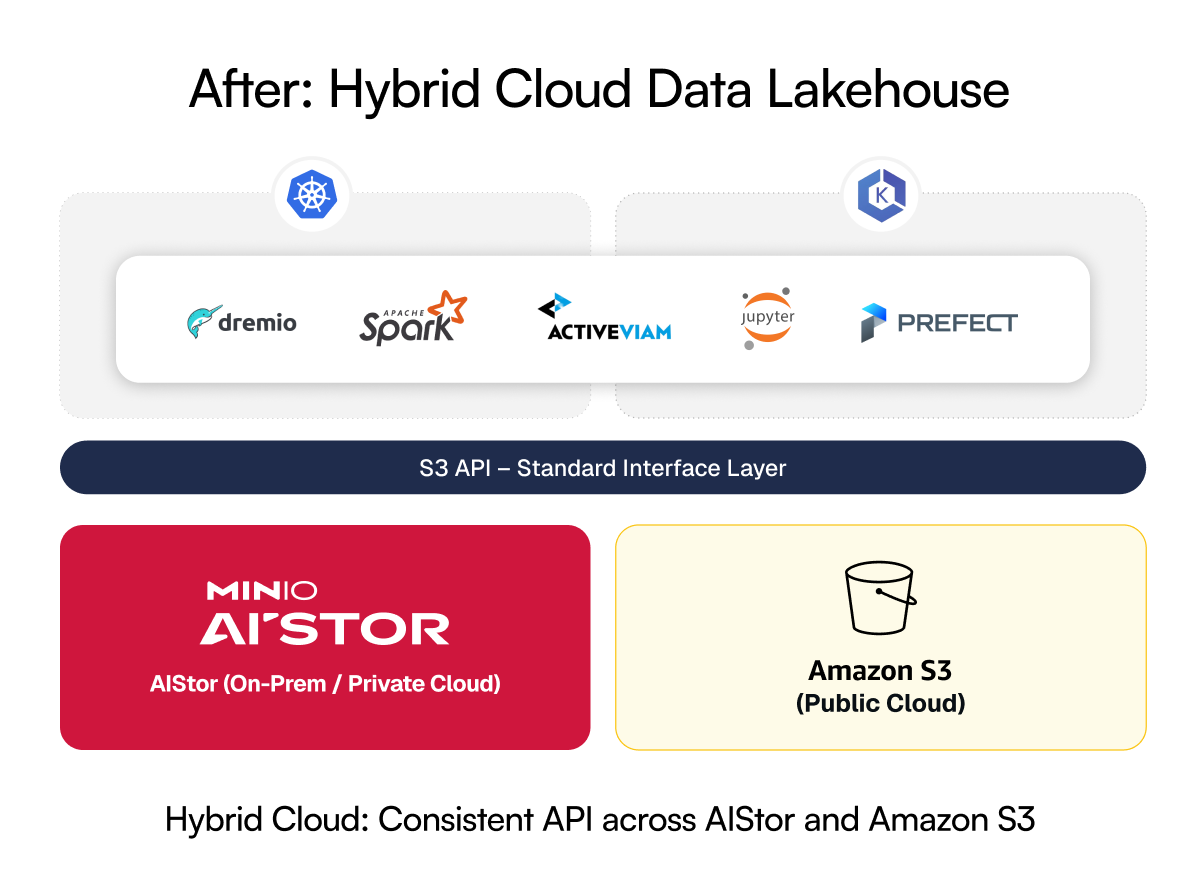
Nomura selected AIStor to modernize its data layer, replacing Hadoop’s HDFS with MinIO AIStor for high-performance, S3-compatible object storage, while retaining Dremio for high-performance interactive queries and business intelligence. By leveraging S3, this also enabled Nomura to use other compute or analytical tools as needed, and avoided the operational burden of refactoring code to use multiple APIs. Working jointly with MinIO engineers, Nomura rapidly deployed a co-located architecture where Dremio and AIStor run on the same Kubernetes-managed hardware cluster, managing 4.5PB of storage across 22 nodes. This allowed the firm to repurpose existing hardware, deferring a potentially significant CapEx expense.
Results & Outcomes
With MinIO AIStor, Nomura achieved a 13.9% performance improvement over its prior Hadoop setup and doubled usable storage efficiency. The firm eliminated instability and improved SLA compliance for mission-critical risk analytics. Moreover, teams can now run production-like workloads in non-prod environments for true regression testing and faster iteration. AIStor’s rapid time to value and overarching simplicity enabled the team to demonstrate these benefits quickly, and also reduce future downtime.
Unexpected Wins
By adopting a software-defined storage layer, Nomura avoided millions in network backbone upgrade costs which would have been required for other solutions. The ability to co-locate compute and storage on repurposed servers enabled Nomura to defer a capital investment in 20+ new servers, while still addressing the underlying challenges and preparing for hybrid cloud and AI workloads.
To learn more about how AIStor can help your organization, contact us using the button below or download a trial version of AIStor here